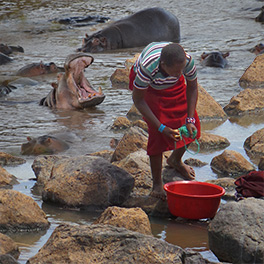
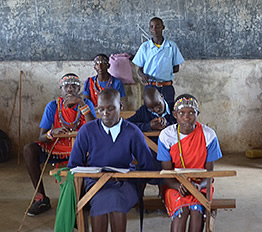


Existing education is very selective. Boys take precedence and are sent to school, while girls are often tasked with collecting water. That takes up so much time that they cannot go to school. Due to the lack of hygiene and clean drinking water, children are often sick and therefore miss school.
A lack of knowledge has consequences for the adults too. It is the underlying cause of the poor hygiene, medical and economic situation.
A lack of knowledge is one of the causes of poverty in Oloonkolin. A lack of knowledge about hygiene causes many health problems. In 2013, 113 children were born in Oloonkolin. Over 1 in 11 children died, of which 33% from diarrhoea (typhoid, cholera, diphtheria). The actual figures are probably higher, because births and deaths of children are often not recorded.
About sixty percent of children that die in Oloonkolin die during childbirth or from complications during childbirth. An unnecessarily high number of people also die from diseases like diphtheria, cholera, typhoid, tuberculosis and malaria. The closest hospital is sixty kilometres away. There are no cars, the roads are bad and completely impassable after rain.
Childhood blindness is common in Oloonkolin due to a lack of knowledge.
A lack of knowledge is also the reason that rituals such as genital mutilation and marrying off of young girls persist. A lack of knowledge also hinders economic development in Oloonkolin. In short, poverty will persist in Oloonkolin without education. Residents need to be aware of the consequences of their behaviour.
Objective
Advice and education will be the key to tackling poverty and improving general living conditions in Oloonkolin. A suitable space is needed for instruction and training.
Community Centre
Previously, events were held "under the tree". The people of Oloonkolin needed an indoor space where they could gather for, amongst others:
• Instruction on hygiene, advice on identifying and preventing health problems
(sexually transmitted diseases such as HIV, amongst others), advice on healthy eating, advice on economic development
• Instruction to children about the importance of good hygiene and healthy eating
• Support for young girls traumatised by genital mutilation
and marrying off
• Support for pregnant women
• Support for mother and baby (a child health clinic)
• Education in economic development (agriculture, sales of jewellery)
• Business plan support
• Church services
Interventions
- Construction of a Community Centre
- Construction of a health centre
- Training of medical specialists
- Advice on hygiene to reduce illness and mortality resulting from poor hygiene
- Development of a curriculum for children at the primary school to teach them about the importance of good hygiene and healthy eating
- Advice and support for mother and baby to reduce childbirth mortality and promote birth control.
- Education in economic development, such as instruction and support in producing agriculture and horticulture-related business plans;
- Advice on medical issues
- Guidance to parents on the importance of education for all children
- Development of support programmes aimed at various age categories (0-5 years, 5-12 years, 12-18 years, 18-22 years, 22 years plus)
- To formulate and uphold rules for mandatory education in consultation with national and local government.